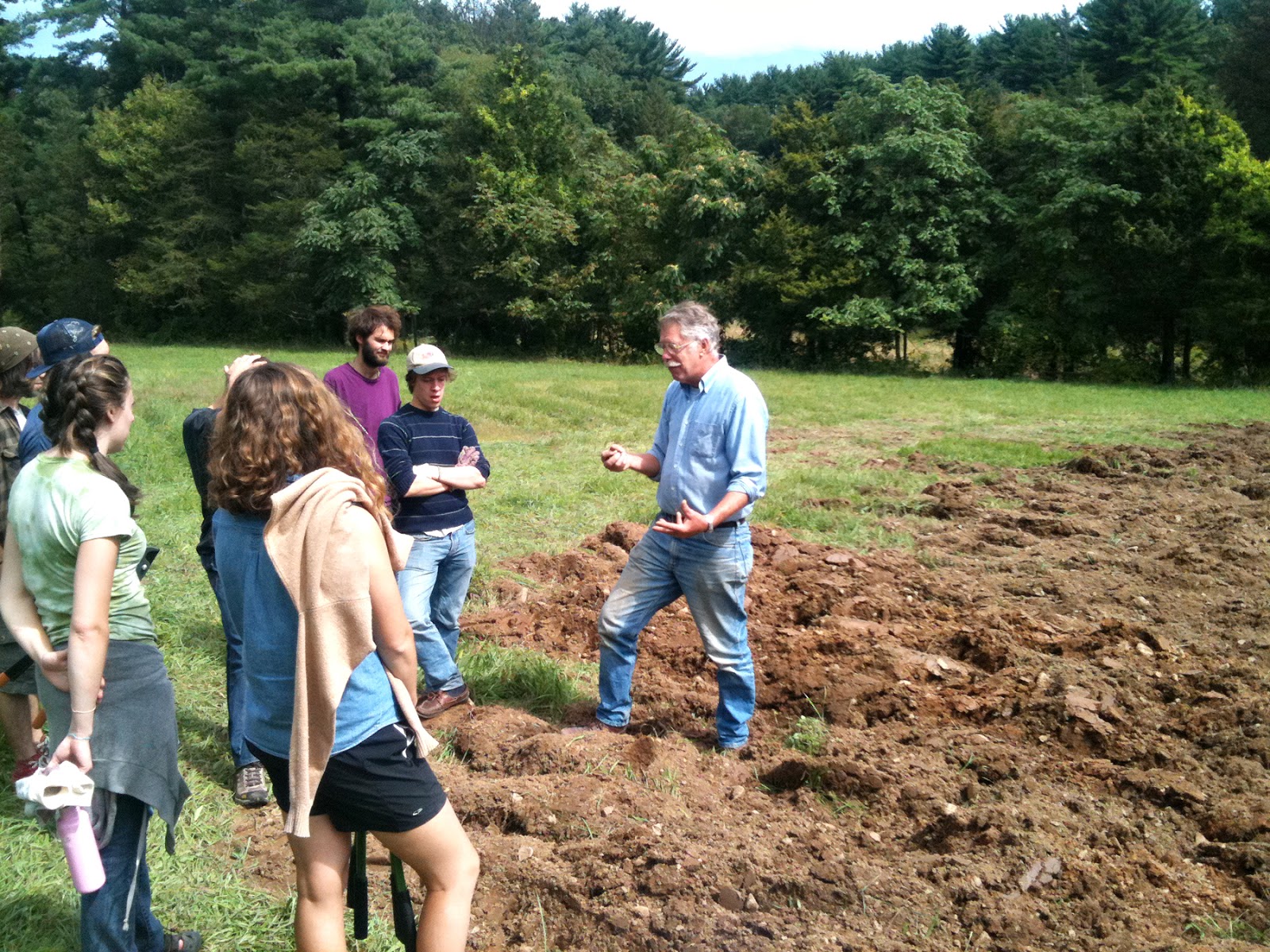
Increase in local farmers and markets a sign of the times.
by Anne Pyburn Craig
Besides being backbreaking, farming is a huge gamble. Farmers are constantly at the mercy of forces beyond their control. Fortunately for those of us who like to eat, we're blessed with a good-sized handful of folks around here who do it anyway.
The state comptroller's office has the stats to prove it: we are one serious produce-growing region around here. Even relatively thickly settled Orange County is one of New York's top producers of veggies. Ulster County is second in apple production. Need a beverage with that? The region's got 39 wineries.
And in so many ways it shapes our reality. Deborah DeWan, executive director of the Rondout Valley Growers Association, points out that when local farmers do their thing we harvest much more than food.
“Supporting local farming keeps our soil protected and our carbon footprint smaller, and preserves all that lovely open space,” DeWan says. “And between agriculture and agritourism, it's about at the top of the local economy. It's a multiplier. I think that speaks volumes about the soil around here and the people who work it.”
Opportunities to feast on this bounty are abundant at this time of year. Local farm stands are bursting with the fruits of the harvest and the wonders created from them, from baked goods to artisanal cheeses and infused oils. More than a few offer pick-your-own opportunities, corn mazes, and other ways to make your grocery expedition about so much more than simply stocking the fridge.
“I think one of the things that's working is how much people enjoy the experience,” says DeWan. “Whether they go picking and get their hands right on the source, or just visit a stand or market, they feel connected to their food in a way you don't get at a chain store.”
After the trauma experienced when thousands of dollars of carefully nurtured crops were ravaged by Hurricanes Irene and Lee (remember all those floating pumpkins?) it's been a comparatively benevolent season.
“I think the harvest is bountiful this year and we are very fortunate and grateful,” says DeWan. “That said, some of our fruit growers are having a somewhat less stellar season. There was a cold snap last spring after a warm spell, so apple and pear trees were tricked into budding and then froze. The results vary from orchard to orchard; it's a mixed bag. But what is being produced is outstanding. And this is prime apple picking time—go grab your stash while you can whether you pick them yourself or hit a stand.”
Many communities have centralized farm markets where you can partake of the wares of a group of growers in one place. “Farm markets are just exploding,” says DeWan. “I think there is a growing awareness of food safety and the food stream in general and that helps.”
So does the fact that market organizers are a creative lot, bringing in music, art and kids' entertainment. Vibrant markets exist in towns from Woodstock to Marlboro, bringing the growers to the people and the people to the growers, reviving the time-honored concept of the market square with a healthy new twist.
Several farm markets, taking advantage of advances in growing techniques and heightened public interest, keep their farm markets going all year long. “There are new innovations that extend the growing season even here in the Northeast,” DeWan says. “Winter markets are growing accordingly.”
DeWan is especially excited about the newest market, and with good reason. Kingston powers-that-be, and citizens, wrung their hands about what to do with the empty lot created by tearing down a derelict eyesore of a welfare motel, the Kings' Inn, that had blighted Midtown for years. Then the farmers' market folks stepped in.
“Some of our members have been going to the new market in Midtown and they say the community has really responded,” says DeWan. “People can use their SNAP [food stamp] benefits there and purchase good fresh food. That's one of the RVGA's goals, to partner with the various initiatives that work to get food to the underserved. It's an ongoing conversation.”
Vendors offering their wares at the Midtown market, which will be ongoing every Tuesday in October, include: Highland Farm, Perez Market Farm, Rexcroft Farm, Slow Roots Farm, Wright's Farm, Abe's Falafel, Al Andaluz Catering Co., All You Knead Artisan Bakers, Block Factory Tamales, DFC Distributors featuring olive oil, Keegan Ales, and El Donzante Food Truck.
The Midtown market is a spinoff of the hugely successful one that takes over part of the uptown Stockade every Saturday morning. Organizers' pride is showing on their website: “The duration of the Market in its inaugural year was scheduled for four months, June through September. Due to the immediate, overwhelming demand for more time, the Market quickly shifted gears and remained open through October. Now in its eleventh year, the Market opens Memorial Weekend and ends the weekend prior to Thanksgiving to allow people to shop locally for fresh items for the holiday. The Kingston Farmers’ Market began with 12 vendors. The Market now has well over 30 vendors...The Kingston Farmers’ Market hosts from between 1,000 to almost 2,000 visitors weekly.”
A recent innovation is farmiemarket.com, an online service working to build a local presence by signing local growers up for its “virtual market.” Customers can order online and have their orders delivered. Farmiemarket tends, at this point, toward the artisanal and niche products, which command a pretty price.
“It's a double-edged sword,” says DeWan. “The farmers operate on a miniscule margin and need to get a fair price. There are getting to be quite a few online buying clubs and we're all for anything that connects farmer to consumer. At the same time we need to keep local products and healthy organic foods accessible. Eating healthier makes a huge difference in people’s lives.”
The RVGA's website offers a “What's Pickin'” guide that will tell you where to find what you're hankerin' for, whether it is grass-fed beef, hormone-free chicken, the makings of a fruit salad, or this year's Halloween pumpkin.
“We're a small organization—only about 60 members—but incredibly diverse and with the benefit of the outrageously rich Rondout Valley soil,” DeWan says. “One thing that I love is that our membership is so varied. We have family operations like the Schoonmakers, who have been farming for twelve generations, and the Davenports and the Kelders, legacy operations. Then we have new growers, CSAs [community supported agriculture], niche operations who may have been around for ten years or may be just starting. And what is really neat is watching everyone work together sharing knowledge and expertise. The longtime farmers are a great resource for the ones just starting out, and the general attitude is that there's always room for another farm. There's a rising tide, what you might call a cross pollination between the generations—old operations and the new CSAs.
“That's a big piece of what we're about, farmer-to-farmer networking, building the community across all facets of agriculture, bringing farmers together to meet and learn what they have in common and what assets might be complementary. If this tradition is to survive on this fertile soil, we need that kind of cohesion.”
When two of Ulster County's most helpful organizations, the Cornell Cooperative Extension and Family of Woodstock, need dollars, as they very much do in the current economic climate, it is to the farmers that they turn. The first annual Hudson Valley Harvest Festival was held on the third weekend in September at the county fairgrounds, and the new endeavor drew high profile sponsors, top-notch local musicians, and crowds. RVGA was there, of course. “We're very much involved in the Farm to Food Pantry initiative and with Family of Woodstock. We made fresh corn chowder with Rondout Valley corn,” DeWan says.
Advocating for local food and local farms is satisfying work as awareness grows. “People are becoming more tuned-in to where their food comes from, the varieties, the seasonal changes,” DeWan says. “It's wonderful. We are so blessed to live in a breadbasket here, a cornucopia. Everyone should take advantage of it. It helps all of us in so many ways."
Right now the RVGA is raising money to match a $25,000 challenge grant from the New World Foundation; they've got until the end of the year and are hoping the community will maintain the wonderful Ulster County tradition of stepping up. There is a “love farmers” button on their website, rondoutvalleygrowers.org, where you can donate before or after snooping out the “What's Pickin'” page to make your grocery list. “Get to know your farmers,” DeWan advises. “Come out to a market or a farm, volunteer at an event, or just 'like' us on Facebook. Everything helps.”
Local tool library seeking tool donations for community.
by Tod Westlake
Libraries have been a part of human culture for close to 5,000 years. From the earliest clay tablets of Sumer to the various classical age libraries, to our own Library of Congress, such public facilities have acted as repositories of our collected wisdom, places where information on virtually every subject is at one's fingertips if you know how to find it. Libraries have also been a powerful force for democracy. It's impossible to imagine the Renaissance, and the Enlightenment that followed, without libraries—even though we humans also have an affection for putting them to the torch every now and again.
Libraries and books are undergoing a major change, however. The Internet and the e-reader are changing our relationship with the printed word, turning what used to be a physical artifact into a fragment of electronic ephemera. The Oxford English Dictionary and the Encyclopedia Britannica, for example, have given up on dead-tree editions and have moved instead to online subscriptions.
But libraries aren't limited to books and research. In recent years there has been a movement toward using the library model for other applications. One example is what's known as a tool library. This idea first appeared in the mid-70s when some folks in Columbus, Ohio got together and began a tool-sharing group. Eventually it turned into a nonprofit organization known as Rebuilding Together Central Ohio. In subsequent years, tool libraries have popped up across the country. There are tool libraries in at least 20 states now.
And we'll be able to add one more to the list in the coming months, as the Ulster County Tool Bank (UCTB) begins operation. A project of Rondout Valley Permaculture, Transition Marbletown, Transition Woodstock, and Sustainable Urubamba Valley, the UCTB will provide local farmers and gardeners with access to gardening tools. Additionally, the group will be collecting old and unwanted non-powered tools that will then be refurbished so that they can be used again, thus preserving dwindling resources and avoiding going into a landfill. Perhaps more importantly, the UCTB will have a social aspect that will, rather appropriately, bring together members of the community in order to share knowledge and ideas.
The project is being coordinated by Wolf Bravo, a farmer and toolmaker who originally hails from Peru. "Both sides of my family were farmers,” he says. “My mother's family in the north on the coast, and my father in the mountains."
Bravo's roots led him into the field of permaculture design, a form of sustainable agriculture in which farms are modeled after the local natural ecosystem. Bravo says that his training has allowed him to gain some perspective on how a group of people putting their ideas together is far more effective than going it alone.
"You see multiple solutions to one problem," Bravo says. "And if we put too much energy into one thing only, we drain ourselves. But, if we can put a little bit of energy together from many individuals, it's better for everyone."
It's not difficult to see how this philosophy translates into the idea of a tool library. Anyone who has lived in the same house for long enough knows full well how easy it is to accumulate enormous amounts of junk. Broken and unwanted gardening tools no doubt sit in backyard sheds and garages across Ulster County. And then there's that shovel handle you backed over in your car a couple of years ago, yet you can't bring yourself to toss it because the good blade is in really good shape. If Bravo has his way, it could live to dig another day.
"I know that there are many people who have a lot of tools, that are old or discarded, that they have no use for, that are broken," Bravo says. "And then there are many people like Aileah, here (Aileah Kvashay, who runs the Clove Valley CSA in High Falls, out of which the UCTB will be based), whom I met at the permaculture meet-up in Marbeltown last year, and she said that she was borrowing tools."
Bravo thought that it was a shame that the CSA might be having difficulties obtaining what it needs. Then he saw a message on Freecycle—an Internet-based network for recycling unwanted, but still useable, stuff—in which someone was giving away a number of tools.
"I picked up like ten tools for free," Bravo says. He eventually gave the tools to a local friend who was putting together her own garden. And in the following months, whenever he would visit the CSA (Bravo lives in Westfield, New Jersey during the week), he would hear the same refrain.
"I kept hearing people say 'I need tools. I need tools,'" Bravo says. He also notes that this reminded him of his own childhood, and how the life of a farmer can be an arduous one, with long hours, and a livelihood that is subject to the whims of nature.
"I was there," Bravo says. "I was working in the fields too. All day in the fields. So I know how it is, and I know that people do it because it's a passion."
This made Bravo want to do something in support of farmers in Ulster County, an area he has come to love. The concept for the UCTB seemed a natural one. "This way they don't have to borrow tools, or spend money on tools, money that can be used for other things, like seeds and fertilizers," Bravo says. "We want to support a safe, local food system, gardeners and farmers alike. Those are our main goals, so the good tools go straight to these folks."
As a first step, the UCTB is now putting the word out that it's collecting tools. And so far, so good. The group has been at this for a few weeks now, and Bravo has been pleasantly surprised by the volume of tools that have shown up at the various drop sites.
The next step, and moving into Bravo's other area of expertise, is the repair phase. Many older tools are of a much higher quality than the ones that can be purchased these days. And modern tools are often shipped half way around the world. Thus putting a new handle on that aforementioned shovel makes good sense from a sustainability perspective. Bravo will also be offering workshops on tool repair, thereby spreading this important knowledge.
"The tools that are broken, or that need repair, we're going to show people how to fix them," Bravo says. "I'm going to be teaching a workshop at each drop site, or in each town where we have a drop site."
Bravo says that the other part of the UCTB is the message regarding sustainability.
"It takes a lot of energy, a lot of oil for transport, a lot of resources to extract the minerals from the earth, to move the minerals to a refinery," Bravo points out. "And then, when it's made, to bring it to the end points for sale. We don't really think about all of this, that the tool we just bought for $30 or $40 might be costing $200 or $300 in lost resources."
When seen in this light, that hunk of metal in your basement represents a huge amount of energy that can remain untapped, resources to be socked away for the inevitable rainy day that is likely just around the next corner.
"In repairing these tools, we're educating individuals about how much it costs, about consumerism, about how we've changed our mentality to consumers instead of producers, of borrowers instead of savers," Bravo says. "We used to save everything. Now our economy is based on consumer debt. How did this happen? How did we get to this point?"
If you're interested in getting rid of your unwanted tools, they can be dropped off through the end of May at the following drop collection sites in Ulster County: High Falls Food Co-op, lower parking lot, corner of Route 213 and Lucas Turnpike, 845-687-7262; Marbletown High Meadow School, 3643 Main Street, Stone Ridge, 845-687-4855; New Paltz, Tweefontein Herb Farm, 4 Jenkins Road, next to front porch of white farm house, call Jens Verhaegh, 845-636-8218; Kingston, South High Street City Farm, 27 South Pine Street, 845-380-9183; Woodstock Library, 845-679-2213. Wolf Bravo can be reached at 973-207-9869, or by emailing wolf.bravo2014@gmail.com.
The group is collecting saws, rakes, shovels, picks, forks, spades, trowels, watering containers, push mowers, scythes, and carpentry tools, as well as buckets, wheelbarrows, and seed spreaders. There is also a need for materials to repair the tools, including wooden handles and hickory, ash, or maple branches or logs. Broken handles will be accepted; however, tools that are rusted through or in need of welding will not be. Again, please note, that the group is not accepting any power tools at this time.
Rosendale’s First CSA has Launched!
by Mimi Quinn
With a huge effort from its core members and a multitude of volunteers, the Binnewater Farm Project (BFP) will be the first-ever Community Supported Agriculture (CSA) in the Town of Rosendale. The CSA will be operating on property they’ve leased from Legacy Farm Cohousing (LFC)—a nine-owner cooperative located off Binnewater Road in Rosendale.
 |
| Dan Guenther with CSA volunteers. |
|
|
|
BFP President Dimitri Galitzine said, “We’re thrilled that Legacy Farm is able to contribute to the creation of this CSA, as sustainability is a keystone of our vision for the cohousing community.”
So how did this all start?
Galitzine said, “We asked Dan Guenther, who had helped to develop a number of CSAs locally, to speak to our group, and we developed the idea of reaching out to folks not involved in developing cohousing to get the project moving. There was strong interest in the local community; the project has really taken off.”
According to Galitzine, the lease is for 10 acres of property (not all of it usable for farming) for one dollar per year. He stated that LFC plans to cluster their development on approximately six acres of the total 56 acres and will leave the remaining land open and undeveloped. The CSA will provide local sustainable food for both LFC and the surrounding community.
A press release dated October 18 stated: “Support for BFP has come in many forms. The group obtained a loan to cover start-up costs from a generous individual who prefers to remain anonymous; all interest from the loan will be paid out in donations of produce to the Rosendale Food Pantry.”
The release also noted that additional support has come from the Bruderhof Community, who plowed the fields in preparation for cover crop cultivation; and from the Students for Sustainable Agriculture at SUNY New Paltz, who participated in farm “work days” by gathering cedar trees to serve as fence posts and helping to spread manure to improve the soil.
In basic terms, a CSA is comprised of a community of individuals who pledge support to a farm operation with the growers, with consumers providing mutual support as well as sharing the benefits of food production. Typically, members or “shareholders” of the CSA pledge to cover anticipated costs of the farm operation and farmer’s salary. In return, they receive shares in the farm’s bounty throughout the growing season.
After putting a “shout-out” for an experienced CSA farmer, Kristen MacDonald was hired. She is relocating from Massachusetts.
“Kristen brings seven years of CSA experience in the Northeast and is very excited about starting up this farm from the ground up,” Galitzine said.
MacDonald said that she looks forward to meeting the community and seeing the farm develop.
“I was really impressed when I learned about the Binnewater Farm Project. To me this project is inspiring and exciting, and I am thrilled for the opportunity to get to be a part of this CSA,” she said.
 |
| Getting ready for garlic planting. |
The official launch of the BFP took place on Saturday, October 29, when the SUNY New Paltz Students for Sustainable Agriculture gathered with BFP volunteers to plant the farm’s first crop—garlic—which will be harvested next year and distributed to CSA members as part of their weekly farm share.
The inauguration was also the start of the promotion for CSA membership for the 2012 growing season. Each share will cost $800 and provide fresh vegetables sufficient for a family of four over the course of a five-month distribution period, which breaks down to about $30 per week.
At this point membership is enthusiastically encouraged and there are many phone numbers and emails on the CSA site for prospective members to contact to join the CSA or volunteer, stated Galitzine.
CSA member Emma Kreyche said, “This is really a team effort. There are so many people who have helped out that are not even part of the core group. My friend Mark is hosting our website on his server; our friend Dave lent us his tiller to till the garlic beds; a student from New Paltz is designing a logo for us...it's really been amazing the way people have rallied behind this project.”
BFP is also seeking volunteers to help install a new fence, set up a greenhouse, repair the barns, and help with both farming and administrative tasks.
To sign up for the CSA, volunteer, or to find out about meeting times and locations please visit binnewaterfarm.org.